For decades, careers followed a predictable formula:
Entry-level → Mid-management → Senior leadership.
Time-bound promotions.
Standardized development programs.
Uniform learning tracks.
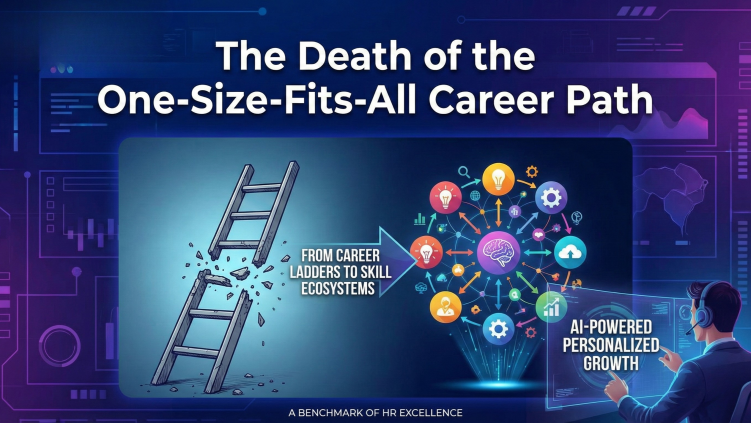
That model is collapsing.
Artificial Intelligence and skills intelligence platforms are redefining how organizations grow talent and in the process, dismantling the traditional career ladder.
The future of talent strategy is not linear.
It is intelligent.
It is skills-based.
It is personalized.
From Career Ladders to Skill Ecosystems
In today’s AI-powered economy:
• Roles evolve faster than job descriptions
• Skills expire faster than titles
• Lateral moves are as valuable as vertical promotions
• Internal mobility is a competitive advantage
Forward-looking organizations are shifting from job-based architecture to skills-based ecosystems.
Because titles describe hierarchy. Skills define capability.
And capability drives business resilience.
The Rise of “Segments of One”
AI now enables organizations to design individualized growth journeys at scale.
Instead of sending 200 managers to the same leadership workshop, companies can now:
• Map real-time skills inventories
• Identify strategic capability gaps
• Predict role readiness
• Recommend personalized learning paths
• Match employees to internal opportunities
The result?
Each employee becomes a “segment of one.”
A distinct portfolio of potential.
This is a precision talent strategy.
Internal Mobility as a Strategic Lever
The most progressive organizations are not just hiring externally, they are unlocking hidden internal capability.
AI-driven talent marketplaces are enabling:
• Cross-functional project matching
• Stretch assignment recommendations
• Skill-aligned mentorship
• Faster redeployment of high-potential talent
Internal mobility is no longer an HR initiative.
It is a growth strategy.
Why This Matters Now
The workforce mindset is evolving:
• Gen Z expects personalized career paths
• Professionals value skill development over static titles
• AI is reshaping capability requirements across industries
Organizations that cling to rigid career ladders risk losing relevance and talent.
Those that embrace skills intelligence build agility, engagement, and long-term advantage.
A Benchmark of HR Excellence
At the PeopleFirst HR Excellence Awards, we are witnessing a clear pattern among leading organizations:
The most future-ready HR teams are:
• Designing skills-based workforce models
• Embedding competency frameworks into decision-making
• Leveraging AI responsibly for talent intelligence
• Redefining internal mobility as a strategic priority
They are not just digitizing HR.
They are redesigning talent architecture.
And that shift is becoming a defining marker of modern HR excellence.
The Strategic Question
The traditional career ladder is fading.
The real question for leaders now is:
Are we developing roles or are we developing people?
Because in the age of AI, competitive advantage will not belong to the most automated organization.
It will belong to the one that can intelligently unlock human potential.
0 Comments